Oolong tea · Wuyi Mountains, China
Bai Ji Guan (White Cockscomb)
Rare Wuyi rock tea with light colored leaves and unique herbaceous character.
 How to brew
| Leaf | Water | Temperature | Time | Infusions | |
|---|---|---|---|---|---|
| Western | 5 g | 250 ml | 90°C / 195°F | 1 min 30 s | 2 |
| Gong Fu | 8 g | 100 ml | 90°C / 195°F | 15 s + | 6 |
About this tea
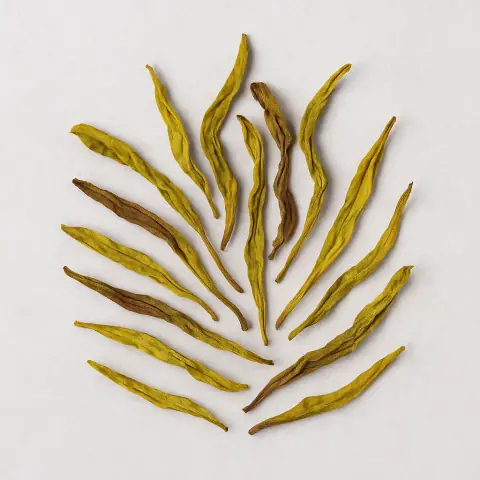
Bai Ji Guan (White Cockscomb) is the most unusual of Wuyi's famous rock oolongs, immediately recognizable by its light yellow-green leaves that stand out dramatically against other dark yancha. Legend tells of a monk whose rooster was killed by an eagle. Where the rooster was buried, a unique tea bush grew with leaves resembling a white cockscomb. This Ming Dynasty origin tea has maintained its distinctive appearance and flavor through centuries.
The cultivar's genetic mutation that produces light-colored leaves also affects its chemistry, creating a unique flavor profile unlike any other yancha. The lack of dark pigmentation means different compounds develop during processing. Grown in Wuyi's mineral-rich cliffs, it requires careful processing - typically lighter oxidation (50-60%) and gentler roasting than other rock oolongs to preserve its delicate character. The finished tea appears almost like a light oolong despite being authentic yancha.
The flavor profile is uniquely herbaceous: distinctive herbal notes dominate - some detect Chinese medicinal herbs, others find mint or basil. The characteristic yancha minerality is present but lighter, more like mountain spring water than rocks. Subtle fruit notes of pear and melon provide sweetness. The texture is surprisingly light for rock tea, refreshing rather than heavy. No roasted character despite being yancha. Multiple infusions maintain the herbaceous character while minerals become more prominent. This challenges expectations of what Wuyi oolong should taste like.
Brewing recommendations: Use 1 tablespoon (5g) per 250ml cup with water at 90°C (195°F), steeping for 90 seconds. Lower temperature than typical yancha preserves delicate notes. For gongfu style, use 7-8g per 100ml, steeping 20-30 seconds initially. Can yield 6-7 unique infusions. White porcelain showcases the unusual leaf color.
Best appreciated by experienced drinkers who can recognize its uniqueness. The herbaceous character makes it perfect for those who find typical yancha too heavy. Pairs well with vegetarian cuisine, fresh herbs, salads, and light Chinese dishes. Also excellent for cleansing the palate. In Chinese medicine, it's considered cooling, unlike warming rock teas. This is the iconoclast of Wuyi teas - refusing to conform to expectations.
Caffeine, in context
Per 250 ml cup, brewed as directed.
Flavor profile
- herbaceous
- mineral
- slightly fruity
- unique
Health benefits
- antioxidants
- cooling
- liver support
- detox
Pairs wonderfully with
- Chinese meals
- herbs
- vegetables
- cleansing
You might also enjoy


Frequently asked questions
Can you re-steep Bai Ji Guan (White Cockscomb)?
Yes — Bai Ji Guan (White Cockscomb) gives 6 good infusions. Start at 15 seconds and add a little time to each round.
How much caffeine is in Bai Ji Guan (White Cockscomb)?
42 mg per 250 ml cup — Medium caffeine.
What water temperature does Bai Ji Guan (White Cockscomb) need?
90°C / 195°F. Hotter water pulls out bitterness; cooler water under-extracts the leaf.
Teafinity times every infusion for you
The app loads this tea's exact schedule, rings even in your pocket, and logs every session — free on iPhone and Android.